Grace for the Girl I Was by Renée Bunker
When I was 16, I observed the red discoloring of my underpants. My face flushed with embarrassment, though I was alone with my period. I felt embarrassed about what womanhood might mean for my body. After reading the instructions on the o.b. Tampons box, I muddled the technique privately. My period lasted a few days and then vanished for a year and a half. I welcomed its absence because, in my teenage-gymnast mind, getting my period meant I was fat.
I fueled my love of gymnastics and fanned into flame my fears of womanhood by increasingly longer summer stints at Woodward Gymnastics Camp in Pennsylvania. I went for two weeks after eighth grade, then four weeks, and then worked for 12 weeks as a junior counselor. The following summer, in 1981, I was selected for an intensive-training program with several girls from around the country.
“Have you gotten your period yet?” one of the coaches asked upon my arrival at Woodward that summer.
“Yeah, somewhat recently,” I replied, as my neck heated and I hoped my cheeks weren’t visibly blushing.
He explained to me something along the lines of, “If you train hard enough, you’ll become a lean, mean, fighting machine, and that’ll be the last time you get your period for a while.”
I absorbed every word he said as though God had spoken. What I heard was: “If you get your period, you’re fat and not a lean, mean, fighting machine.” That’s not what he said, but that’s what I heard. I was 17 years old, impressionable, and only on the heels of my second period.
Each morning, we ran as a flock of young gymnasts from the house on the hill where we stayed. We jogged along the lush green and occasional browning farmland, increasing our distance each day or week by counting the number of telephone poles we passed beyond camp. We then circled back to camp for breakfast in the dining hall before dance lessons that my awkward body needed amidst its self-conscious shadow.
We got weighed twice a day: once in the morning and once in the late afternoon. Did I mention we got weighed twice a day?
Some of us began spitting to weigh less. We leaned out the open window of the dance studio into the hot summer air, spat as much saliva as we could, and merged back into the dance lesson. Not one of us was overweight.
A camp friend and I started talking about throwing-up. I heard several other girls (and guys) were doing it and I was intrigued. A bit leery, but very intrigued. Throwing-up, like spitting, just seemed like one of the tools of the trade of gymnastics to be employed if you wanted to get ahead. And I wanted to get ahead. My friend didn’t encourage me to vomit. But as I recall, she explained how to try to trigger a gag response.
Thereafter, during one of our Wednesdays off, our group went into State College for the afternoon with an adult chaperone. We went to the locally famous Meyer Dairy, “Meyer’s,” for ice cream. My lower belly and throat were nervous, as though a conspiratorial current ran between them. I walked into Meyer’s hoping I’d have an opportunity to try to barf the ice cream I hadn’t yet purchased. I can’t recall what I purchased, probably two scoops of smooth, chocolate or mocha ice cream made from all-natural dairy products. This was “healthy” ice cream insofar as ice cream goes, but there was no such thing in the face of my fear of fat.
After I finished my ice cream, I went outside, looked around to see who might be watching, saw nobody interested, and walked around to the back of the building. With one side of my body flanked close to the building that I hoped would shield my misconduct, I leaned over and repeatedly tried to induce vomiting. It wasn’t easy. My eyes watered from the effort and my stomach was tight with fear of getting caught. I vomited some of the ice cream that my insides had made warm, wiped my hands on a flimsy white paper napkin, and carried relief and guilt with me as I rejoined the group in the parking lot.
~
Decades of eating disorders, self-loathing, and accomplishments followed. They included a four-year full athletic scholarship to Penn State, the highs and lows of intense gymnastics competition, law school, an Ironman triathlon, and service as an assistant United States attorney in San Diego and Maine. Decades of treatment, recovery, serial relapses, and then sustained recovery followed. I re-embodied love.
~
“We are!” one of us shouted from the bleachers at Penn State’s Rec Hall.
“Penn State!” replied a caucus of fans and teammates, former coaches, and trainers dressed in blue-and-white attire.
“WE ARE!” the first choir shouted with increased heat.
“PENN STATE!” the responders exclaimed with pride.
We’d gathered for a Penn State Gymnastics reunion in February 2020 and attended a meet at Rec Hall. The night before the meet, some of us gathered at Whiskers, a bar, and then another bar. There, my teammates, former coaches, and I slid smoothly into each other’s hugs and laughter. Eating disorders that had haunted some of us or tempted others, or not, were spoken legacies. Love, kisses, shared drinks, and hugs dominated.
On Sunday morning, my hotel roommate, Betsy, and I staggered our shower and makeup preparations for a gymnastics-reunion brunch. I rode in the passenger seat of Betsy’s SUV and remained overwhelmed by how much had changed in State College since the last time I was there. We pulled into the driveway of a hotel to pick-up another teammate.
“Hi!” I shouted across the hotel lobby as my teammate, Lynne, continued to pay attention to the stairs she was descending. We hugged, walked outside, and climbed into the SUV.
The sun shone brilliantly as we drove out of State College along South Atherton Street. The previous morning’s snowfall had melted. Green grass marked the roadside, reminding me that spring was around the corner as I felt the warmth of our teammate musings.
Using one of my nicknames, Betsy interjected, “Oh my God. Bunk! We’re here. We gotta go!”
My heart jumped at her excitement. I looked ahead and saw the big wooden sign she pointed at. It boasted a fulsome white cow with dark spots. Above the cow, etched in bold white lettering, I read, MEYER DAIRY.
I had shared with several former teammates and enduring friends that the first place I ever self-induced vomiting was at Meyer Dairy. I told them, “If we get the chance while we’re in State College, I’d love to return to Meyer’s and just have an ice cream with friends, enjoy it without stress or any desire to get rid of it.” But the weekend got busy and I’d forgotten about Meyer’s.
“We can’t go now,” I told Betsy. “It’s 9:30 in the morning!” I looked at my phone. “It’s 10 ‘til 10. They’re probably not even open.”
Betsy pulled into the empty parking lot. “We’ll see,” she said, opening her car door. She charged up the cement walkway and yanked open one of the entrance doors. I looked over my shoulder at Lynne in the rear seat as I shared an abbreviated version of what precipitated this Meyer’s recovery mission.
Betsy came bolting out of Meyer’s. “They’re open!” she shouted.
“You are so funny!” I said.
Her excitement pumped me up as though we were about to compete in a gymnastics meet. We were instead taking back the sanctity of Meyer’s and ice cream with friends.
“Ice cream for breakfast before brunch?” I asked them.
“Yes!” they confirmed.
I’d had ice cream many times at Meyer’s since my teenage years, through college and graduate school. I doubt I ever retained the indulgence without vomiting or exercising to compensate. “Okay!” I said, opening the car door.
I walked into the restaurant and scanned the dining area to the left, ice cream counter straight ahead, and the grocery section to my right. A man entered behind me and went to buy a clear jar of milk that I knew came from a pure wholesome cow.
“I need to go outside for a minute,” I said to my friends.
“Does that door work?” I asked the clerk as I gestured to two glass doors, bright white with sunlight shining in at the far end of the dining room. She confirmed I could go out and come back through those doors.
“Go ahead and order. I’m paying!” I said to my teammates as I walked toward the dining room.
I went outside and walked cautiously in my stumpy-heeled boots down a steep grassy embankment along the side of the building’s brick exterior. At the bottom of the hill, I turned to face the back of Meyer Dairy. She was still there. Now a memory I watched as a third-party observer from afar, no longer engrossed by my eleventh-grade maturing body and fear-filled mind.
I saw a teenage Renée, “Bunko,” doing her best to rid herself of the ice cream she’d just enjoyed. The ice cream that passed in reverse through her gagging throat and that made a mess on her hands and napkin, on her soul and integrity.
I no longer hated her for feeling that she was too much and not enough at the same time. I wanted to approach her as she bent over trying to make herself less in order to be more. I wanted to hold her as she hid with shame that she didn’t know would snowball for decades to come. I wanted to ask her questions that might’ve helped her, then.
How can I love you? How can I love you without judgment? How can I intervene now to curtail your pain, shame, or fear? How can I help you know you’re lovable, the whole of you? How can I show you another way and hold you until you believe it’s okay, that you are okay and beautiful?
My friends and ice cream were waiting inside. I swept my left arm up and forward in a gesture to lure that teenager leaning against the building in for a hug, to hold her under my wing and walk with her up the hill and back into Meyer’s.
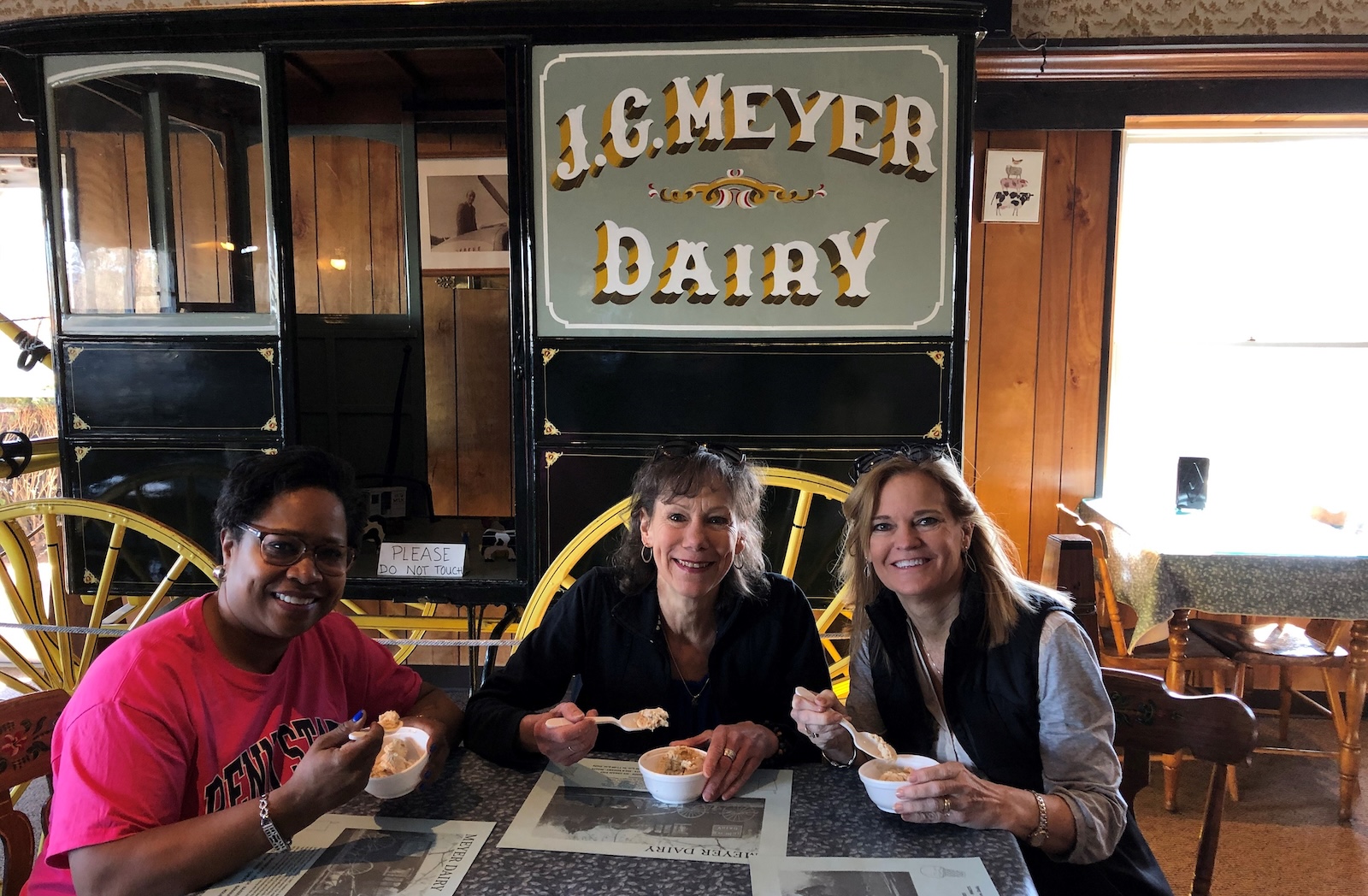
Teammate Betsy stood beaming at a square table for four in the dining room spooning ice cream from one Styrofoam cup into three. “I hope coffee’s okay,” I recall her saying. “It is, after all, breakfast.”
“I love coffee ice cream,” I said.
Betsy explained, “They weren’t actually serving ice cream yet, but I begged her to give us three scoops and told her it was a special occasion.”
We laughed, took our seats at the table, and used plastic spoons to dip into our breakfast. A young man had entered the store and we asked if he’d take pictures of our spectacle. We were the only ones in the dining area, the only ones eating ice cream for breakfast at 10 a.m. on our way to brunch. The young man took pictures with our phones.
“He was cute,” I said, after the door closed behind him. Or was that the eleventh-grader speaking, the girl for whom I’d found grace and brought back inside for carefree ice cream? The man was closer in age to the eleventh-grader than to me. But I felt giddy with my teammates rejoicing in this reclaimed indulgence.
My palate welcomed each spoonful of the cold, creamy, coffee-flavored delight. My throat soothed with knowing that the ice cream would flow in only one direction, toward nourishing my belly, body, and soul. Spaces once consumed with fear, guilt, and shame now had room for giddiness, grace, and love.
 Renée Bunker lives in Portland, Maine and works as a mediator, legal consultant, and author. She earned a full athletic scholarship and competed as an NCAA Division I gymnast at the Pennsylvania State University, where she obtained a bachelor’s degree in psychology and master’s in political science. Renée obtained her law degree at Northeastern University and served as a federal prosecutor for 21 years. She wrote hundreds of legal briefs and served two years as Appellate Chief. Having recovered from eating disorders, Renée advocates for prevention, treatment, and recovery. She has also served as a guest on podcasts discussing eating disorders and the Harvey Weinstein convictions.