
The Grass Basket, An Alaskan Tale by Mary George
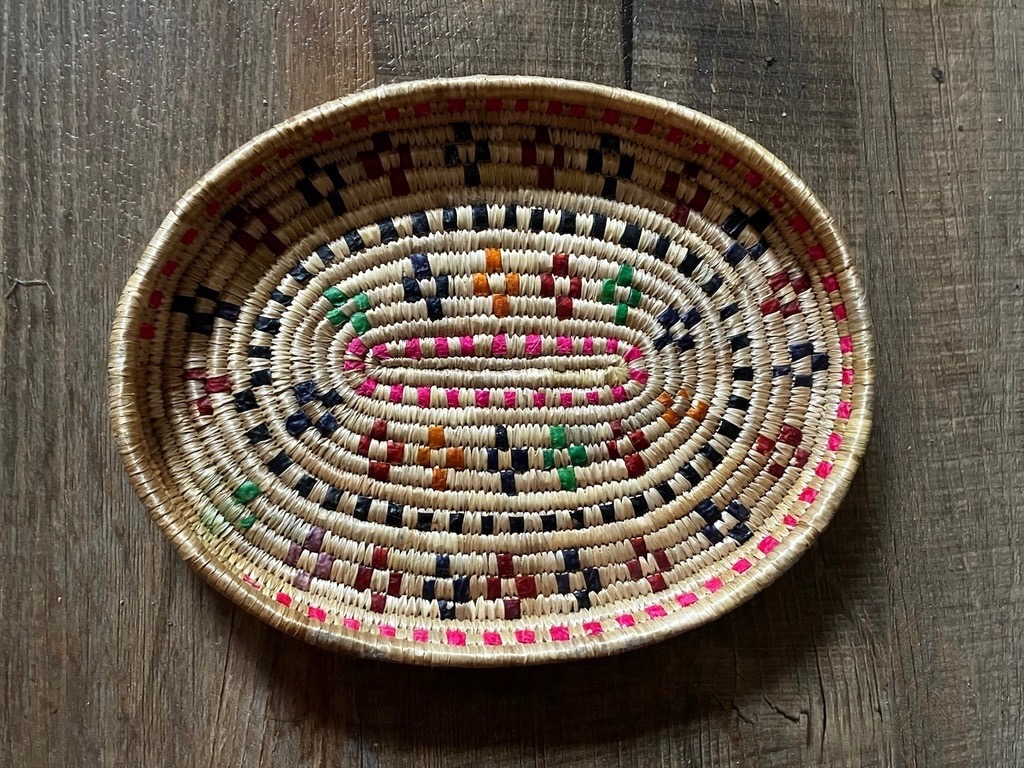
On the other side of the arctic entry door, Julia stood, softly knocking. Surprised, Marla opened the door to see a young woman crying. Marla ushered her inside to the warm living room where an old rusty woodstove burned hot. As she looked at her to check for any distinguishing qualities, she saw none. When she looked closer, into her eyes, she recognized the eyes of a child she’d once known.
Many years had passed since they had seen one another. Forgotten years; lives lived, tossed aside only to be lived again; in a new house, with a new partner, children born and raised; a miscarriage or two; a few pounds gained and lost; hair colored purple and brought back to its natural hues.
Marla hugged her.
“Why are you crying?”
“I just wanted to see you. Rumors floated that you lived here now. I needed someone to talk to.”
Marla was older. She was the young woman’s mother’s age. She was her aunt, Yup’ik way.
“Why are you here? So far from home?”
“I thought you had baskets, and I wanted company.”
“Yes, I have some old ones. Hidden in a brown box. Stored in a corner. In the dark. I am very happy to see you.”
“I love those old baskets,” Julia announced, “they are truly rare. Sometimes the old woman weaver talks to me in the middle of the afternoon. Although it has been such a long time since her death, her spirit follows me and I am unable to shake her off. It’s difficult to forget her. I close my eyes, and plug my ears, but images of her surface, and her words, I can never forget them.”
“Oh?”
Marla had lived on the coast, in Kipnuk, and remembered the teenager. She was an eager and hopeful girl, in love with her boyfriend. She had married young, soon after she became pregnant. Neither of them graduated from high school, but he landed a job with GCI and ran telephone wires across the village. It wasn’t much in the way of money, but a job, none-the-less. They lived meagerly in a small one room cabin constructed of plywood. One window faced Tern Mountain, a small volcanic mound which was a landmark on the tundra between the villages of Kipnuk and Chefornak. A warm spring separated them near the eastern side of the volcano where villagers would snogo to for fresh drinking water.
During those times in her life, when Julia awoke in the mornings, she would peer out her window to see the mountain across the distance; it stood higher than the land and line of the horizon. Colorful tundra in summer and fall, white and clean in winter. Flat lands, volcano, river and sea everywhere she looked. The lakes, like jewelry, shone in the rain, or sun, hidden under the snow.
Marla watched Julia’s tears turn to laughter. Emotions, swirled directionless, circular, and filled the kitchen as she heated water for cups of tea.
Marla asked Julia about the Kipnuk grass basket the old weaver woman had woven. It was a rare type of basket and Marla had helped the weaver, after her nimble fingers lost elasticity and her eyes grew weak. The grasses she had selected were tough and wind worn. Rit-dyed seal gut had been interlaced within the weaving to create a design or image of an upright fat goose with flat black feet. She remembered when she had picked the grass for the old woman. It was fall and she had chosen the places along the ocean where the currents toughened them. The smell of the Bering Sea winds she preferred. And when they dried, they were the bleached beach yellow color. When she returned from her walks, she cleaned, braided, and hung them across the back wall in her living room between two nails that she had nailed for that purpose. Anyone entering would see them hanging strewn across the wall, earthy and natural looking. She gifted them to the old woman; Marla tied them together with colorful pink cloth. Afterwards, she rolled them and tied them, ready for weaving.
Hm, I knew her well, she thought. I cared for her when her eyes weakened. I would thread her needles and place them in her fingers. Each blade of grass slid between my lips and tongue. The old woman held the baskets in her lap, set them aside, and would wind herself around some dark corner of her back room and return with bundles tied in pastel cloth. While sewing, she struggled with each weave. But her memorized movements helped with each stitch. Like the rhythm of the wind, where the grass grew, it was nature extending all its powers, whether out in the fresh air, or inside the house with her family.
“What does she say to you?” Marla asked.
“She’s not happy with me. I can feel her needles prickling at the sides of my ribcage. Small blotches of blood stain my blouse. The blue bruises bite and bulge.”
Marla turned to the young woman while beneath her smile a dark, round spool of thread glued itself to her tongue. She hid it with her hand. Then she pretended to cough and sneeze. She excused herself.
“I need to use your bathroom.”
When she returned to the room, the spool had disappeared and she appeared normal.
“You are far from home.”
“Yes, my mother bought me a ticket. I left Ron. I flew here a month ago.”
“Oh, I see. Where are you staying?”
“Around the corner at Wasilie’s house. I live with him and his children. I met him on Facebook.”
Marla was surprised. She remembered when she was a little girl. Their houses faced one another separated by a narrow boardwalk, and in the mornings, Julia’s father brushed his teeth, opened the window and threw out the cup of water while watching the sunrise. In the afternoons, Marla and Julia’s mom would drink tea and toss gossip about like a couple of seagulls.
She was named after her grandmother, Julia, on her mother’s side. Old Julia lived along the boardwalk a few steps away in a very large house painted green with windows on all sides so that the sun shone inside and on the coldest days, when the wind blew in minus degree temperatures, there was warmth. Not only from the sun, but emanating from the oil cook stove, where a pot of seal soup boiled on most days.
“Well, I had nowhere to go.” Julia looked straight into Marla’s eyes. Marla recognized the vacant glare. Many young women stare back, unafraid to gamble their fates. Without saying, Marla had guessed she left him and flown as far up the river as she could go.
“How many children do you have now?”
“I have seven. One of my twins is disabled and needs full time care.” She hesitated, but then said, “I miss them.”
“I’m sure you do,” Marla answered. “It’s hard like that, leaving your children. They must miss you also.”
It was a conundrum. Dissatisfied women living in rural Alaska had to struggle to care for their children. It had become a common practice to abandon them to their fathers and move on to live with a different partner. Heartache and loneliness created deep chasms difficult to fill.
“Well, I have a few relatives here, and you.”
“And Wasilie.”
“Of course, Wasilie.”
“Facebook Wasilie,” Marla said smiling.
“I came by because I want you to keep something for me,” Julia said.
“What’s that?”
“I want you to keep my basket.”
“Which basket?”
“The one where Roy keeps all of his keys.”
“What, you mean you brought Roy’s basket to Wasilie’s?”
“I couldn’t leave it behind. She gave it to me. The old woman weaver relentlessly told me not to leave the basket and to take it wherever I live.”
“Oh, I see.”
“What?” Julia asked.
Marla ruminated before she could answer Julia. She felt as though she needed to slow down and not nudge her, to watch her like a bear cub, try sensitivity and awareness to keep her from falling into a dark tunnel. Women needed someone to listen. No need to try and fix them, but to show love in subtle, gentle ways.
“I see the old woman weaver has returned. You brought her with you. You brought her and she brought your husband, Roy.”
“What do you mean, Marla, I don’t understand.”
“Give me the basket,” Marla consented.
Julia unfolded the basket from her backpack and removed the newspaper wrapping. She placed it on the table, and from the corner of her eye, Marla spied the old woman weaver. It was subtle but in character with how she conducted her affairs. Marla decided to store it in the brown box that she had hidden.
“I am thinking that you shouldn’t come back too soon, Julia.”
“Why would you say that, Marla?”
“I’m trying to protect you,” Marla said. “I knew her once upon a time. Knew her well.”
“Do you know something I don’t know, Auntie?”
“Well, my little niece. You will learn soon enough, if you haven’t already. It’s not an easy road you are taking. What do you know about Wasilie? He’s married, you know. Separated, I suppose. Like you and Ron.”
Marla didn’t have the heart to explain it to her. The complications involved with leaving one family to join another were enormous. The distance between the villages would make it difficult to see her children. If she continued to travel back and forth, the men’s dispositions would change towards her. If either of them started drinking, she’d need protection.
“Your mother-in-law was my aunt. I spent most of my life around her. When she became feeble, I lived in her house and cared for her. She was a loyal woman who believed in family.”
“I believe in family.”
“Yes, but you’ve left yours and your husband to live here with another man.”
Julia touched her stomach and made a motion to show how it was growing. Marla smiled. Quietly she bent her ear and whispered, “Congratulations. A new child is always worth a celebration.”
“It’s Wasilie’s.”
“Yes, I can see.”
“Have you thought about what you will do?”
“No, not really. Just that I won’t be drinking.”
Marla nodded, “You should sit down. I’ll fix you some tea. We’ll have dry fish and salmon berry agutaq.”
Julia stayed the afternoon while Marla knitted a pair of colorful blue and grey socks for her husband. He preferred knitted socks; he was the type of man who was out in the weather and his toes would ache from the damp. It relaxed her to knit. Julia watched and slept in the dark brown armchair that faced the window with views of the river. It shone warmly and cast a beam upon Julia’s face. As Marla watched her, she felt protective and wondered, How can I help her? What can I do?
A few weeks and Marla had an inkling about Julia. In the evening, she opened her closet, and reached for the basket. She thought that she had stored it on the floor, but when she looked, it was gone. She turned off the lights, lay on her bed and closed her eyes. In the morning, she rushed over to Wasilie’s house. When she entered, Wasilie smiled a greeting. His house was quiet and the children slept on the couch under red handmade quilts. In the kitchen, Julia was brewing morning coffee.
“Auntie, good morning. So good to see you. Sit and have coffee with us.”
“Yes, yes, good morning, niece.”
“What brings you here so early, Auntie?”
“Oh, I was worried about you. Something like a feather has been tickling my throat, and my neck, and now my eye is twitching. I went to the closet to look for your basket, but I couldn’t find it. Do you know where it is?”
They sipped their coffee together, making slurping noises, which caused them to giggle. Marla placed her spoon in her cup and stirred the sugar and milk into swirls. When she looked up from her cup, she thought she saw something moving across Wasilie’s kitchen wall.
Two paired Yup’ik masks hung near the window. Outside the window a tundra lake sparkled and thick willow trees grew on the far side. The masks were a pair. One was black and she hung close to her male counterpart, a grizzly bear. Each yua or spirit was marked differently. The grizzly mask on the left side of the window had its second face carved over the bear’s right eye. His snout narrowed towards a point of the nose. The soft wood carving revealed a narrow-left eye. The mask on the right of the window had its yua carved directly in the center of the black bear’s head. The spirit was smiling in a round carved-out face. Its two eyes watched directly below and smoothed out into a narrow snout. Their head feathers were missing. As Marla viewed them, she thought about bringing goose feathers the next time she visited, to place them at the head of each mask. She also thought the grizzly had a male appearance and the black bear was a female. What was painted red in the grizzly was painted black on the black bear. Each was slender and soft and old, belonging to the last remaining of the old world.
These were healing masks, unlike the old woman’s basket. The closer she looked she could see that their spirits were joyful. This pleased her and brought her a sense of tranquility. The basket made her nervous. Marla was suspicious that the old woman would haunt her and her niece. Jealous of her niece’s new found happiness, the old woman weaver would find a way to wreak havoc upon them. Women like her would do anything for their children and grandchildren.
“What did you do with the basket, Niece?”
“Oh, Marla, I forgot to tell you. Last week I went to your house and asked my uncle to find it for me.”
“Oh, my husband didn’t say anything. He must have forgotten.”
“Oh, it’s in the bedroom. I took it out of the box, unwrapped it and placed it next to my bed. I felt lonely for that fat goose with the black feet.”
“Oh, I see.”
The effects of the nostalgia could devastate Julia. Marla recognized the power of the basket, and the lure of it in Julia’s life. Wanting to see it, touch it, smell the Bering Sea scents when she opened the lid to remember the stability and ties to her original life with her family and ancestors.
“Have you had any troubling experiences lately? Have your eyes grown dim? Have your ears dulled or your lips gone salty?”
“Well, now that you mention it, Auntie, I have had some trouble. My back has a pain underneath my shoulder blade.”
“Oh, ya, I was afraid of that. So, how are you and Wasilie doing?”
“Good, Auntie. We’re doing good. But I’m going home soon.”
“Oh, well, O.K. I’ll miss you, Niece.”
Marla felt a deep pain of remorse. She hadn’t gotten a chance to counsel her niece. She had been afraid to speak honestly and hid her true feelings. It was difficult to guide a young woman in the ways of love. Most difficult when the man you love becomes careless with his words and unfaithful in his actions.
“I brought you a present, Julia.”
Marla placed her hands in her pockets and gave her a little white box. Inside were a pair of black and red earrings carved from ivory and mastodon with a red gem inserted into a tiny hole. They hung long from each ear when the niece looped them into her ear holes.
“Quyana, Auntie. I love them. From where? Who made them?”
“Oh, your uncle carved them. When he showed this pair to me, I knew they fit you so well.”
Julia hugged Marla. When Marla looked up, she noticed a movement near the grizzly bear’s face.
“Sit down, Julia. We need to talk.”
“What is it, Auntie?”
“How is your baby? Have you gone to your prematernal appointments in Bethel?”
“Well, I missed the last one due to weather.”
“Are you sleeping well?”
“Most nights. Sometimes I cramp in my stomach, but it goes away.”
“Are you walking and exercising?”
“Most days. I walk over to the lake and back. Sometimes when I get to the other side, I take a short nap.”
“Do you notice anything strange when you sleep?”
“Sometimes, Auntie. Why?”
“You need to be careful. We can talk about it the next time I visit you.”
“Well, I’m planning on going home.”
“Oh, why would you go now? Don’t you think it is risky? With the baby and all? What does Wasilie say about you going?”
Marla stood and looked out Julia’s window. The wind had turned and the clouds showed unusual colors of layered grays with tints of red from where they hid the sun; it was an alternating light and dark colored sky. She looked towards the masks and saw the strange movement. She couldn’t recognize it, but her intuition knew.
“Julia, I have a favor to ask of you.”
“What, Auntie?”
Her earrings shimmered as she moved her head in Marla’s direction. She looked so beautiful, her long hair braided and hung down her back. Her eyes sparkled with the hope of new life.
“The next time you take your walk to the lake, carry Roy’s basket with you in your backpack. Here, I have a rock for you. Place the rock inside the basket and throw it towards the deepest part of the lake.”
“But, Auntie, why?”
“That old woman weaver will cause you and your baby pain.”
Two days later Marla unlatched the door to her shed and pulled her kayaq from the hooks on which it hung. She placed it awkwardly on the rack behind her four-wheeler seat and drove through the tundra as far as she could adjacent to the lake. A loon couple was dipping and as she paddled, they flew in flapping motion to the lake on the rear-side of the willow forest that separated the two. As Marla paddled towards the center of the lake she stopped and floated the kayaq. When she looked down into the depth of the water, she saw caribou antlers. Beneath the antlers she recognized old bulging eyes. As the caribou surfaced, Marla grabbed her bow and arrow and shot into the water. The antlers sank deeper and deeper and the image of a fat goose with flat black feet rose to the surface and disappeared.
Now, Marla thought to herself, Julia and her baby can rest easy. She paddled back to the shore of the lake and looked towards the sun. She rested her eyes as the heat penetrated, closed them to feel a deep relaxation, and thanked her ancestors for their help this day.
The End
 A recipient of the 2026 Alaska Center for the Book and the Andy Hope Literature award from Cirque, 2023, Mary George teaches and writes in the rural community of Akiachak, Alaska.